Car Lease vs Buy in Salt Lake City, UT: 2026 Guide
Leasing vs buying a car in Salt Lake City? Compare Utah sales tax rules, monthly costs, mileage limits, and resale value to pick the right path.

For most Salt Lake City drivers, leasing makes sense if you want a lower monthly payment, drive under 12,000-15,000 miles a year, and prefer swapping cars every 36 months. Buying wins if you plan to keep the vehicle five-plus years, drive long distances along the Wasatch Front, or want to build equity. Utah's sales tax rules differ meaningfully between the two paths — and that difference alone can move the math by hundreds of dollars a year.
How does Utah sales tax change the lease vs buy math in Salt Lake City?
In Utah, sales tax on a purchase is charged on the full price at the time of sale, per Utah Code Ann. §59-12-102. On a lease, sales tax is applied only to each monthly payment as it's made, and if you exercise an end-of-lease buyout, that buyout is treated as a separate taxable sale. That structure often lowers the upfront tax bite on a lease.
Salt Lake County adds local option tax on top of the state rate, and combined rates vary by municipality — the Utah State Tax Commission's rate tables are the authoritative source for your exact ZIP. If a dealer or lessor fails to collect the tax, the buyer or lessee is on the hook for use tax, reported on Form TC-62S, TC-62M, or the TC-40 income tax return. Stores like Strong Volkswagen on State Street handle this collection at signing, so most Salt Lake City buyers never file separately.
What's the real monthly cost difference between leasing and buying?
Leases typically run 20-40% lower per month than a comparable loan payment on the same vehicle, because you're only financing the depreciation during the lease term plus interest — not the whole car. A purchase loan builds equity; a lease payment doesn't. Over a 36-month window, leasing usually wins on cash flow; buying usually wins on total cost if you keep the car past the loan payoff.
A quick side-by-side on the same $35,000 vehicle in the Salt Lake City market:
| Factor | Lease (36 mo) | Finance (60 mo) |
|---|---|---|
| Typical monthly payment | Lower | Higher |
| Utah sales tax basis | Charged on each monthly payment | Charged on full purchase price at sale |
| Mileage limits | Yes (usually 10k-15k/yr) | None |
| End of term | Return, buy, or re-lease (buyout = new taxable sale) | You own it, free and clear |
| Customization | Restricted | Unlimited |
| Best for | Predictable commuters, tech-features shoppers | Long holders, high-mile drivers, DIY owners |
Does Salt Lake City driving favor leasing or buying?
Salt Lake City's mix of short in-town commutes and long weekend runs to Park City, Moab, or Bear Lake pushes many drivers past standard 12,000-mile lease caps. If your commute is a few miles across the Avenues, Sugar House, or downtown, a lease's mileage cap is easy to stay under. If you're regularly heading up I-80 to the Uintas or south on I-15 to St. George, buying usually pencils out better than paying over-mileage penalties at lease-end.
Climate matters too. Wasatch Front winters mean road salt, snowpack, and inversion-season grime. Lease returns require the car to come back in reasonable condition; owned vehicles let you defer cosmetic wear without penalty. Drivers who ski Little Cottonwood every weekend often prefer to buy — chains, roof boxes, and gravel chips add up fast on a leased return.
How do end-of-term options compare in Utah?
At lease-end in Utah, you have three options: return the vehicle, buy it out, or roll into a new lease. The buyout triggers a separate taxable sale under Utah law, with sales tax due on the buyout price as its own transaction. A financed vehicle simply becomes yours when the loan is paid — no additional tax event.
That extra tax hit on a lease buyout is why buyers who suspect they'll want to keep the car should usually finance from the start. If you're genuinely undecided, a lease preserves optionality — but budget for the buyout tax if you end up loving the car.
When does leasing make more sense for Salt Lake City drivers?
Lease if you want a new car every three years, drive predictable miles, value the latest driver-assistance tech, and want lower monthly outflow. Leasing also shines on EVs and plug-in hybrids where technology is evolving fast — you're not stuck with an older battery or infotainment stack five years from now. Business use is another lease-friendly case, since payments may be deductible (check with your CPA).
- You drive under 12,000-15,000 miles per year
- You want a warranty covering the entire ownership period
- You dislike selling or trading in used cars
- You prefer predictable monthly costs with minimal repair exposure
When does buying make more sense?
Buy if you plan to keep the car five years or longer, drive high mileage, customize your vehicle, or want to eliminate a car payment entirely someday. Owned vehicles have no mileage penalties, no wear-and-tear inspections, and no return deadlines — the flexibility Salt Lake City outdoor lifestyles reward. Over a 7-10 year hold, buying almost always beats consecutive leases on total cost.
- You drive over 15,000 miles per year
- You want to modify the vehicle (racks, lift, wraps, tint)
- You plan to hand the car down or resell privately
- You want equity you can trade in on your next vehicle
How should you actually decide between leasing and buying in Salt Lake City?
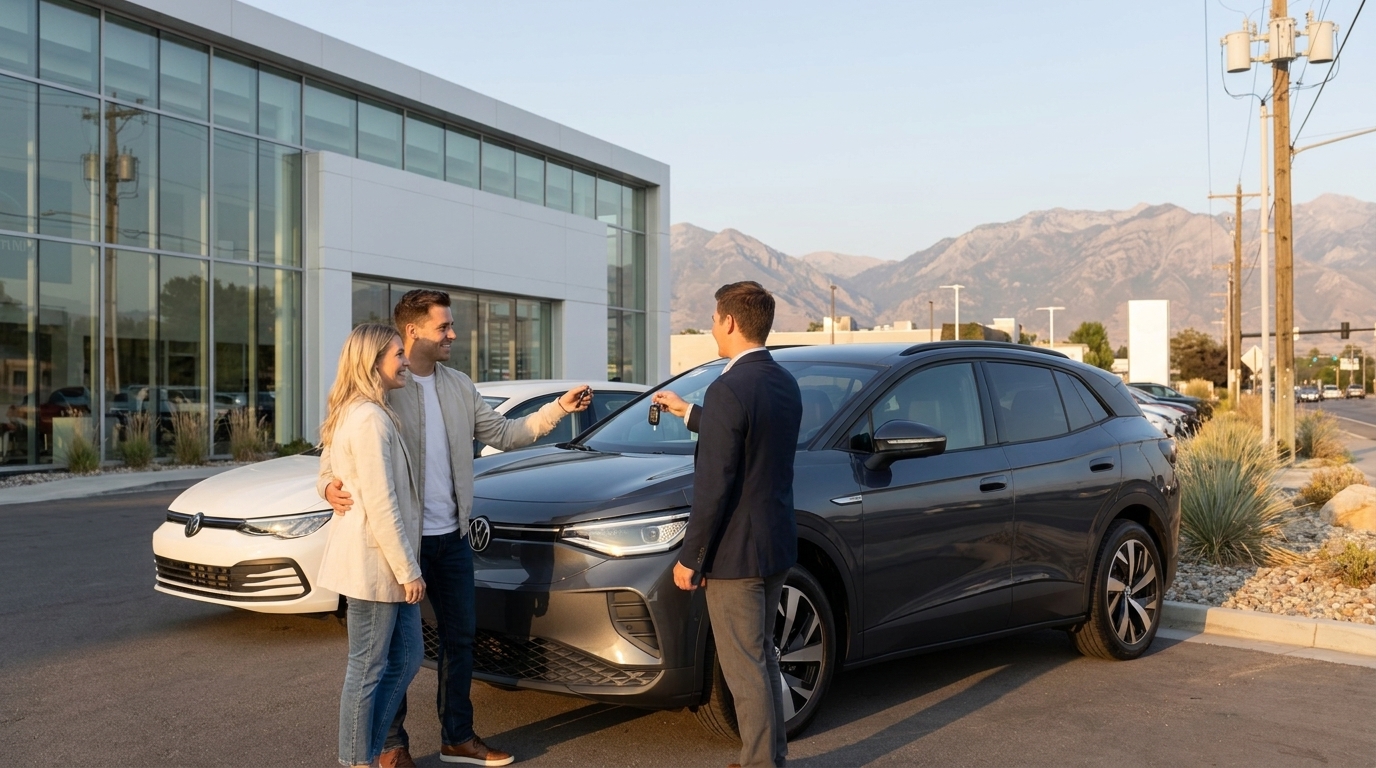
Run the numbers on the same vehicle both ways — monthly payment, Utah sales tax treatment, expected miles, and how long you realistically keep cars. A dealer that shows you both quotes side-by-side without pressure is doing the job right. Strong Volkswagen's approach reflects that kind of straightforward dealing.
Ask for the money factor (lease interest rate equivalent), the residual value, the acquisition and disposition fees, and the exact tax breakdown for your Salt Lake City ZIP. If any of those are missing from a lease quote, you don't have a real quote yet.
Frequently asked questions
Is sales tax cheaper on a lease or a purchase in Utah?
In Utah, sales tax on a purchase is charged on the full price at the time of sale, while lease tax is charged on each monthly payment. That typically means less tax paid upfront on a lease, though total tax over a long ownership period on a purchased vehicle can be lower than tax on back-to-back leases. Exact rates depend on your Salt Lake City locality.
What happens tax-wise if I buy my leased car at the end?
Under Utah Code Ann. §59-12-102, exercising a lease-end purchase option is treated as a separate taxable sale. Utah sales tax is due on the buyout price as a distinct transaction, on top of the sales tax you already paid on each monthly lease payment. Factor this into your decision if there's any chance you'll keep the car.
How many miles per year does a typical lease allow?
Standard leases allow 10,000, 12,000, or 15,000 miles per year, with per-mile overage fees at lease-end. Salt Lake City drivers who regularly head to Moab, Park City, or St. George should estimate honestly and buy extra miles up front if needed — pre-purchased miles cost less than overage penalties. If you consistently drive over 15,000 miles annually, financing is usually the better path.
Can I negotiate a lease the same way I negotiate a purchase?
Yes. The vehicle's capitalized cost (selling price) is negotiable on a lease just as it is on a purchase. You can also ask about the money factor and any dealer add-ons. What you cannot negotiate is the residual value, which is set by the lender. Always compare the total lease cost, not just the monthly payment.
Do I pay Utah sales tax if I lease a car in Salt Lake City but move out of state?
Utah sales tax is generally collected on lease payments while the vehicle is used or registered in Utah. If you relocate mid-lease, tax treatment shifts to the new state's rules for the remainder of the term. Notify your lessor promptly, and consult the Utah State Tax Commission or your new state's tax authority to confirm your specific obligations.
Is it easier to get approved for a lease or a loan?
Leases typically require stronger credit than financing because the lender takes on residual-value risk. Buyers with credit challenges often have more loan options — including longer-term or subprime programs — than lease options. That said, captive lender programs from manufacturers can offer competitive lease approvals to a wide credit range, especially on current-year models.
The bottom line for Salt Lake City drivers
Leasing and buying aren't good or bad — they answer different questions. Lease if you want lower payments, newer tech, and flexibility every three years. Buy if you want long-term value, unlimited miles for Wasatch adventures, and equity at the end. Utah's tax treatment nudges the math in ways worth understanding before you sign.
Salt Lake City drivers who want both quotes worked up on the same vehicle — with the Utah tax breakdown, money factor, and residual all on the table — can reach Strong Volkswagen at https://www.strongvw.com to compare side-by-side and pick the path that fits.