Utah Trade-In Tax Credit at a Salt Lake City VW Dealer
How Utah's trade-in sales tax credit lowers your taxable price at a Salt Lake City VW dealership — the rules, documentation, and real-world savings.
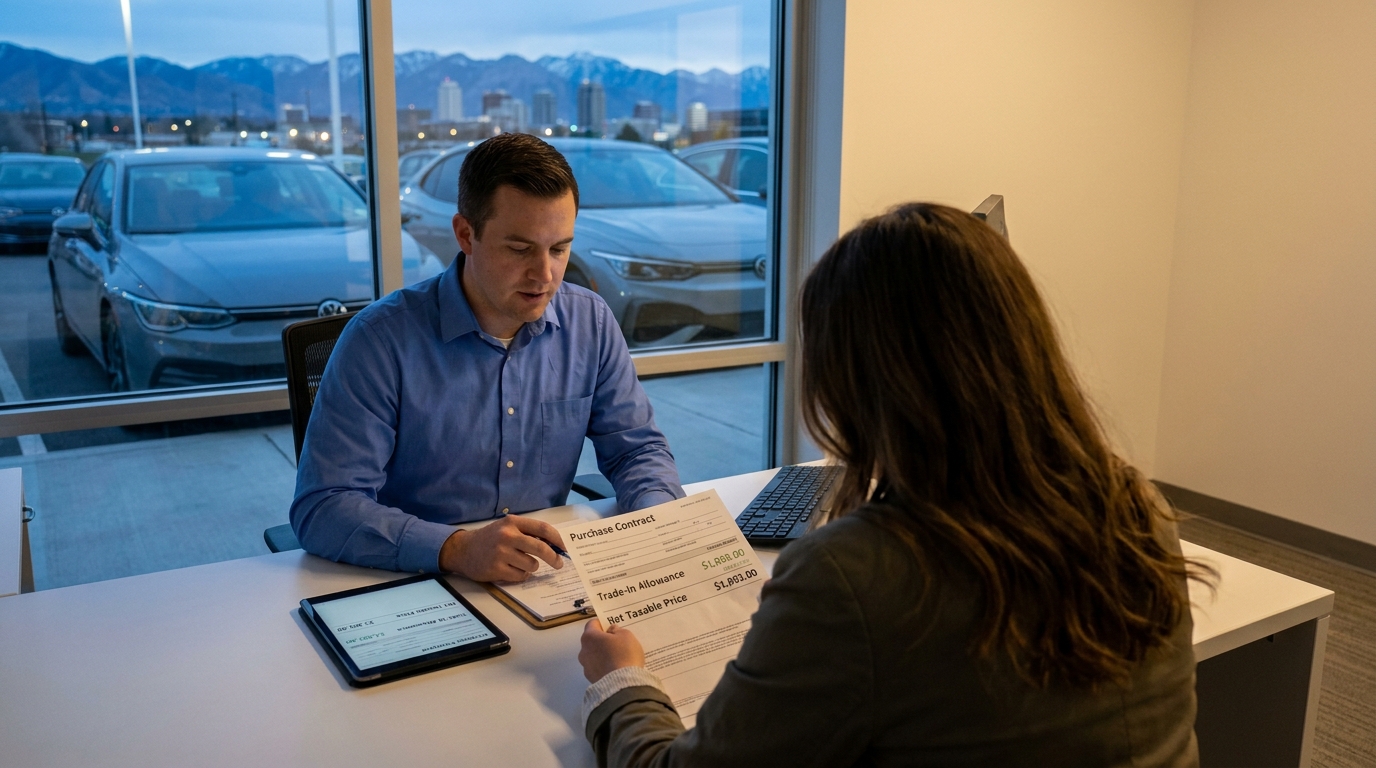
In Utah, when you trade a titled vehicle in on a new or used car at a licensed dealership, the state applies sales tax only to the net purchase price — the sticker price minus your trade-in allowance. Under Utah Code § 59-12-102, that trade-in credit directly reduces the taxable amount, so the 4.85% state sales tax (plus local option taxes) is calculated on the smaller number. For a Salt Lake City buyer rolling equity from a current car into a new Volkswagen, that can shave hundreds — sometimes thousands — off the out-the-door price.
Below is how the rule actually works at a Salt Lake City VW dealership, what has to be on the paperwork, and where buyers most often trip themselves up.
How does Utah's trade-in tax credit work when buying a Volkswagen in Salt Lake City?
Utah taxes the net purchase price of a vehicle: gross price minus the agreed trade-in value of a qualifying titled vehicle, exchanged in the same transaction. The state rate of 4.85% under Utah Code § 59-12-103, plus Salt Lake County and city local option taxes, is then applied only to that reduced figure — not to the original sticker.
Here's the arithmetic in plain terms. If you're buying a new Volkswagen Tiguan priced at $34,000 and you trade in a vehicle the dealer values at $14,000, Utah only taxes the $20,000 difference. At the 4.85% state rate alone, that's the difference between tax on $34,000 and tax on $20,000 — a meaningful reduction before local rates are even layered in. Local option taxes in Salt Lake City push the combined rate higher, which is exactly why the credit matters more here than the headline state rate suggests.
Strong Volkswagen structures its purchase contracts to document the trade-in and the net taxable amount on the same bill of sale — which is what Utah's rule requires for the credit to apply.
What has to be on the paperwork for the trade-in credit to count?
The trade-in vehicle's year, make, VIN, and agreed value must be documented on the dealer's bill of sale or purchase contract, and the trade must happen simultaneously with the purchase. Without a compliant bill of sale, the Utah DMV assesses tax on fair market value under Utah Code § 59-2-102 instead of on the net price you actually paid.
In practical terms, that means the trade-in has to be a titled motor vehicle — not a boat trailer with a lost title, not a project car sitting on someone else's registration. The paperwork requirements are enforced at the point of title and registration, so a sloppy bill of sale can cost you the credit even if the dealer intended to apply it. Any reputable Salt Lake City VW dealership, Strong Volkswagen included, will walk through the trade-in line-items with you before you sign.
What doesn't qualify as a trade-in under Utah law?
Utah's trade-in credit is limited to titled motor vehicles exchanged in the same transaction. Selling your old car privately and bringing cash to the dealer does not qualify — the full purchase price of the new vehicle becomes taxable. Non-vehicle property (appliances, tools, electronics, labor, other personal property) also cannot reduce the taxable amount.
- Private sale proceeds: If you sell your current car to a neighbor and bring the check to a Salt Lake City dealership, there is no trade-in credit. You'll pay tax on the full price of the Volkswagen.
- Non-vehicle trades: A jet ski without a motor-vehicle title, tools, or a riding mower cannot offset the taxable price.
- Leases and short-term rentals: Under HB 77 (2026), lease and rental transactions are taxed separately, and trade-in credits generally do not apply. If you're evaluating Volkswagen finance offers versus lease deals in Salt Lake City, the tax treatment is a real variable — a purchase with a trade-in behaves very differently from a lease with a trade-in.
- Non-dealer purchases: Per SB 217 (2026), private-party trade-ins are limited to other vehicles only, with strict documentation and valuation rules.
How much does the credit actually save a Salt Lake City buyer?
Savings scale directly with the trade-in value and the combined local tax rate. The state portion is fixed at 4.85%, but Salt Lake City buyers pay additional local option taxes on top, so every dollar of trade-in value removed from the taxable base saves more here than it would in a lower-tax county.
Rough illustration using the state rate only:
| Gross VW price | Trade-in value | Net taxable | State tax at 4.85% (net) | State tax at 4.85% (no trade) |
|---|---|---|---|---|
| $28,000 | $8,000 | $20,000 | $970 | $1,358 |
| $34,000 | $14,000 | $20,000 | $970 | $1,649 |
| $42,000 | $18,000 | $24,000 | $1,164 | $2,037 |
These figures reflect state sales tax only — the actual savings at a Salt Lake City dealership are larger once local option taxes are included. Confirm the combined rate for your specific transaction location; combined rates vary by city, county, and special district.
Does the trade-in credit apply to certified pre-owned Volkswagens too?
Yes. Utah's trade-in tax credit applies to any qualifying vehicle purchase at a licensed dealer, including certified pre-owned Volkswagens. The rule is about how the taxable amount is calculated, not about whether the vehicle is new or used. A CPO Jetta, Atlas, or ID.4 purchased with a documented trade-in is taxed on the net price the same way a brand-new Tiguan would be.
That parity matters for shoppers weighing a new model against a certified pre-owned Volkswagen. The tax math doesn't change; the sticker price does. Strong Volkswagen carries both new and CPO inventory and applies the same trade-in documentation process to either.
Frequently asked questions
Does Utah tax the full price of my new Volkswagen or just the difference after trade-in?
Utah taxes only the difference. Under Utah Code § 59-12-102, when you trade a titled vehicle in at a licensed dealer as part of the same transaction, the taxable amount is the gross purchase price minus the trade-in value. The 4.85% state sales tax plus local option taxes apply only to that net figure, not the full sticker price.
What if I sell my current car privately and bring cash to a Salt Lake City VW dealer?
You lose the trade-in tax credit. Utah's rule requires a qualifying titled vehicle to be exchanged simultaneously as part of the same dealer transaction. If you sell separately and bring proceeds, the full purchase price of the new Volkswagen becomes taxable. Buyers often save more overall by trading in at the dealership, even at a slightly lower allowance.
What documentation does the dealer need to apply the trade-in credit?
The bill of sale or purchase contract must show the trade-in vehicle's year, make, VIN, and agreed value, alongside the gross price of the vehicle being purchased and the net taxable amount. If a compliant bill of sale isn't presented at title and registration, the Utah DMV taxes the transaction based on fair market value under Utah Code § 59-2-102 instead.
Does the trade-in credit apply to Volkswagen leases in Salt Lake City?
Generally, no. Under HB 77 (2026), short-term vehicle leases and rentals are subject to separate tax treatment, and trade-in credits typically do not apply to lease transactions the way they apply to purchases. If you're comparing Volkswagen lease deals against finance offers, ask the dealer to walk through the tax treatment of each path — the numbers can shift the decision.
Can I trade in a non-vehicle item to reduce the tax on my Volkswagen?
No. Utah law restricts the trade-in credit to titled motor vehicles. Appliances, tools, electronics, labor, or other personal property cannot reduce the taxable purchase price of a vehicle. Only a qualifying titled vehicle, exchanged in the same dealer transaction, moves the tax base down.
What sales tax rate will I actually pay at a Salt Lake City dealership?
The state rate is 4.85% under Utah Code § 59-12-103, and Salt Lake City buyers pay additional local option taxes on top, so the combined rate is higher than the state figure alone. The exact combined rate depends on the specific transaction location within Salt Lake County. Your dealer will calculate the applicable combined rate on the net taxable price at the time of purchase.
Where this leaves Salt Lake City buyers
Utah's trade-in tax credit is one of the more buyer-friendly features of the state's vehicle tax code, but it only helps if the transaction is documented correctly and structured through a licensed dealer. The rule is not universal — buyers moving from California, for example, pay tax on the full purchase price with no trade-in offset — so it's worth using while you're here.
Salt Lake City shoppers who want the trade-in credit applied cleanly, with the year, make, VIN, and agreed value documented on a compliant bill of sale, can reach Strong Volkswagen at https://www.strongvw.com to see current inventory, get a written trade-in appraisal, and review Volkswagen finance offers alongside the net taxable price.
This article summarizes Utah's regulatory framework as of 2026 and is not tax or legal advice. For guidance on a specific transaction, consult the Utah State Tax Commission or a qualified tax professional.