Volkswagen Atlas vs Ford Explorer: The Family SUV Breakdown
Compare the 2026 Volkswagen Atlas vs 2026 Ford Explorer on space, power, warranty, and family fit for West Valley City, UT drivers.
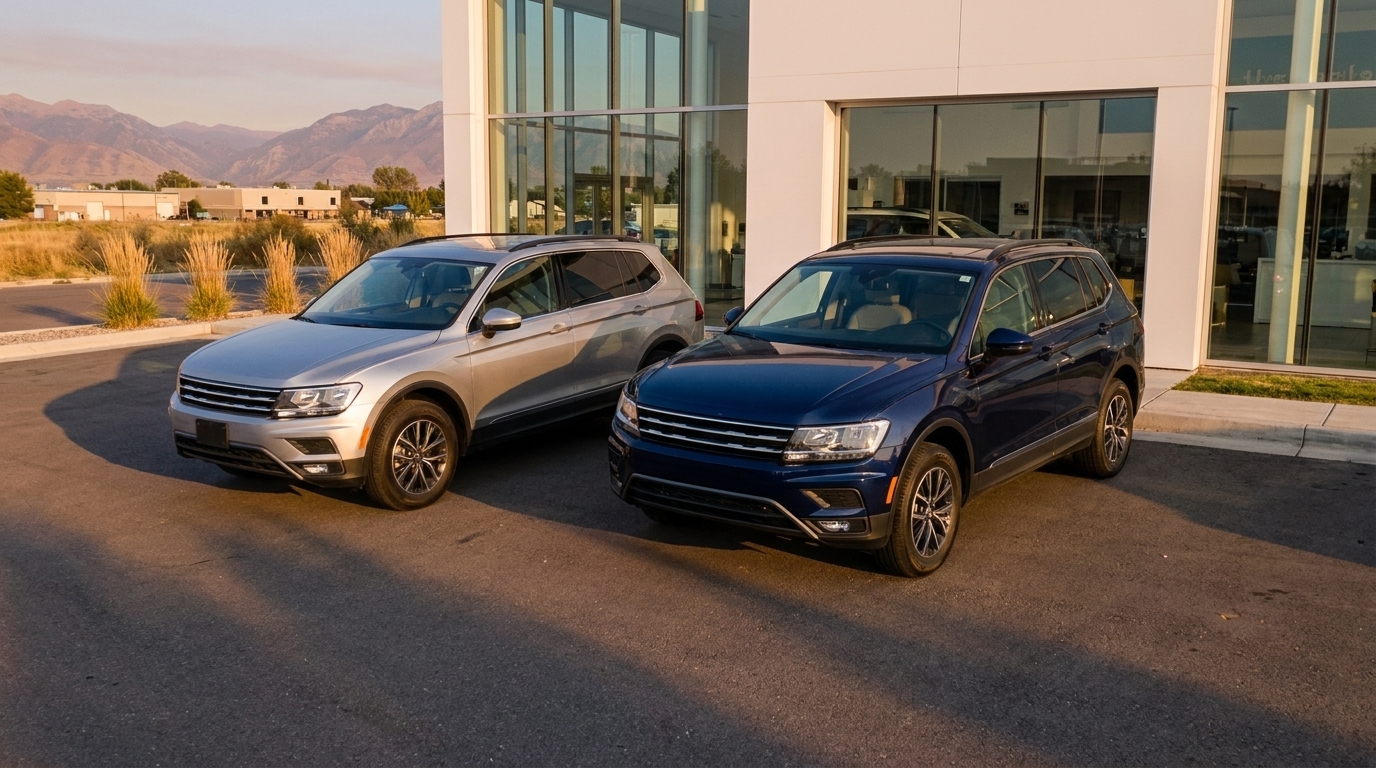
Families in West Valley City cross-shopping a three-row SUV usually land on the same short list: the 2026 Volkswagen Atlas and the 2026 Ford Explorer. Both seat up to seven, both tow 5,000 pounds, and both start within a similar range of each other. The right answer depends on how you weigh interior space against powertrain choice, and how often you'll point the nose toward Little Cottonwood or the Mineral Basin on a snowy Saturday.
Here's a direct breakdown of where each SUV wins, what it costs, and which one fits a Salt Lake Valley family best.
Atlas vs Explorer Third Row Space and Cargo
If you regularly carry kids, gear, and a Costco run home from the West Valley store on 5600 West, interior volume matters more than spec-sheet horsepower.
The 2026 Volkswagen Atlas leads here, and it isn't close:
- Atlas cargo: 20.6 cu ft behind the third row, 96.6 cu ft maximum with seats folded
- Explorer cargo: 16.3 cu ft behind the third row, 85.8 cu ft maximum
That's roughly 4.3 cu ft more behind the third row in the Atlas and about 10–11 cu ft more at maximum capacity. For families packing strollers, ski bags, and weekend luggage for a drive to Park City, the Atlas swallows more without making someone ride with a duffel on their lap.
Seating is a near-tie. The Atlas seats 7 standard. The Explorer also offers up to 7 passengers, with bench or captain's chairs determining 6 or 7 depending on trim.
Which third row is more usable?
Both third rows are workable for kids and short adult trips. The Atlas provides 33.7 inches of third-row legroom, making it more practical for families who regularly seat adults or older children in the back. If the third row is occupied weekly, the Atlas's extra cargo room behind it is the real differentiator.
Powertrain and Performance
This is where the Explorer pulls ahead.
2026 Volkswagen Atlas:
- 2.0L turbocharged TSI inline-4
- 269 hp @ 5,500 rpm / 273 lb-ft @ 1,600 rpm
- 8-speed automatic; single engine across all five trims
2026 Ford Explorer:
- 2.3L turbocharged EcoBoost I-4: 300 hp / 310 lb-ft; 10-speed automatic
- 3.0L twin-turbocharged EcoBoost V6 (available on ST, Tremor, and Platinum): up to 400 hp
The Explorer's base engine already out-muscles the Atlas by 31 hp, and the available V6 adds considerably more on top of that. If you tow a small trailer up I-80 toward Wyoming or want a quicker on-ramp merge onto Bangerter Highway, the Explorer's powertrain catalog is the more flexible choice.
That said, the Atlas's single-engine strategy keeps trim shopping simple. Every Atlas — SE through SEL Premium R-Line — drives the same way, and the 269 hp turbo-4 has more than enough torque for daily Salt Lake commuting.
Fuel Economy
Combined EPA estimates are close across both lineups, with variation depending on engine choice and drivetrain configuration. The Atlas's estimates are consistent and clearly published across its full trim range. The Explorer's fuel economy varies more widely depending on whether you choose the base four-cylinder or the available V6, and whether you opt for rear-wheel drive or four-wheel drive. Real-world economy in the Salt Lake Valley depends heavily on altitude, winter fuel blends, and how often you climb canyon grades. Contact Strong Volkswagen for current trim-specific details that reflect your likely driving mix.
AWD, Snow, and Utah Winter Driving
This is the category West Valley City buyers should weigh hardest. Wasatch Front winters mean inversion, black ice on Bangerter, and weeks where Parley's and Little Cottonwood close on short notice.
Atlas: FWD standard, 4MOTION AWD available. 4MOTION is tuned primarily for on-road traction stability — it's competent in snow and the right setup for the vast majority of suburban Utah driving.
Explorer: RWD standard, Intelligent 4WD available with Terrain Management System. The Terrain Management presets (including snow and mud/ruts modes) give the Explorer an edge for buyers who actually use forest service roads near Mirror Lake Highway or push past pavement at trailheads. The Tremor trim adds up to 8.7 inches of ground clearance compared to the standard 7.6 inches.
For pavement-only families who just want confidence on a snowy school morning in Granger or Hunter, the Atlas's 4MOTION is plenty. For buyers who tow, off-road lightly, or commute up canyon roads, the Explorer's 4WD system is the more capable hardware.
Atlas vs Explorer Price in West Valley City
Published MSRPs for both vehicles are in a similar range at their respective entry points. Pricing varies by trim, drivetrain, and any current manufacturer incentives. Because dealer incentives, documentation fees, and Utah sales tax all affect your final out-the-door number, the only reliable figure is a written quote tied to a specific vehicle. West Valley City buyers should note that Utah's combined sales tax rate applies to the purchase price, and trade-in credit can reduce the taxable amount. Contact Strong Volkswagen for a current, itemized out-the-door quote on any Atlas trim.
Utah-specific note: there is no Utah-specific MSRP. Pricing is national, with local doc fees, Utah sales tax, and any current manufacturer incentives layered on top. Always confirm out-the-door numbers with the dealer before signing.
5-Year Cost of Ownership
Long-term ownership cost is shaped by depreciation, fuel, insurance, and maintenance. The Atlas includes two years of scheduled maintenance as part of its warranty package, which can reduce out-of-pocket service costs in the early ownership period. For a personalized cost comparison based on your expected mileage and trim choice, ask Strong Volkswagen to walk through the numbers with you.
VW Atlas vs Ford Explorer Reliability and Warranty
Coverage tilts toward Ford on the powertrain side and toward VW on bumper-to-bumper duration:
- Atlas: 4 years / 50,000 miles basic (bumper-to-bumper); 4 years / 50,000 miles powertrain; 7 years / 100,000 miles corrosion; 2 years / 20,000 miles scheduled maintenance included
- Explorer: 3 years / 36,000 miles basic; 5 years / 60,000 miles powertrain; 5 years / 60,000 miles roadside assistance
The Atlas gives you a longer basic warranty — useful for the small electronic and trim issues that typically show up in years 3–4. The Explorer's longer powertrain coverage protects the bigger-ticket components further out. The Atlas also includes scheduled maintenance for the first two years, a tangible savings. Neither warranty alone should make the decision, but the Atlas's 4/50,000 basic is genuinely above-average for the segment.
Best Family SUV Comparison: Which One Fits Which Buyer
Choose the 2026 Volkswagen Atlas if you:
- Need the most cargo room behind the third row
- Want straightforward trim shopping with one well-sized engine
- Drive mostly pavement and value a longer basic warranty plus included maintenance
- Prioritize third-row legroom for adults or older children on regular trips
Choose the 2026 Ford Explorer if you:
- Want a V6 option or more horsepower at the base level
- Regularly drive canyon roads, tow, or go light off-road
- Prefer a 4WD system with Terrain Management presets
- Want a performance-oriented (ST) or off-road-focused (Tremor) trim variant
FAQs
Is the Atlas or Explorer better for Utah winters?
Both handle Salt Lake Valley winters well with their AWD systems. The Explorer's Intelligent 4WD with Terrain Management has an edge for canyon driving and light off-road; the Atlas's 4MOTION AWD is well-suited to pavement and suburban use.
Which has more third-row space?
The Atlas. It offers 20.6 cu ft behind the third row vs. 16.3 cu ft in the Explorer, and 96.6 cu ft maximum vs. 85.8 cu ft. The Atlas also provides 33.7 inches of third-row legroom, making it the stronger choice for families who regularly seat adults or older children back there.
Which is cheaper to own long-term?
The Atlas includes two years of complimentary scheduled maintenance, which reduces early out-of-pocket service costs. For a full long-term cost comparison based on your specific trim and mileage, contact Strong Volkswagen for a personalized breakdown.
Does the Explorer still come with a V6?
Yes. The 3.0L twin-turbocharged EcoBoost V6 is available on the ST, Tremor, and Platinum trims. Horsepower ratings for this engine vary slightly across official sources; verify the exact figure on the window sticker of any specific vehicle you're considering.
How do the towing capacities compare between the Atlas and Explorer?
Both the 2026 Atlas and 2026 Explorer are rated at up to 5,000 pounds when properly equipped — an exact tie. The Explorer includes a Class III Tow Package as standard equipment, while Atlas towing capability is configuration-dependent. If towing is a priority, confirm the specific hitch and wiring setup on any vehicle you're considering.
Which SUV has the better warranty, and does it matter for Utah buyers?
The Atlas offers a longer basic warranty (4 years/50,000 miles vs. the Explorer's 3 years/36,000 miles) and includes two years of scheduled maintenance. The Explorer counters with a longer powertrain warranty (5 years/60,000 miles). For Utah buyers who plan to keep the vehicle past 50,000 miles, the Explorer's powertrain coverage provides an added safety net on the drivetrain.
The Bottom Line for West Valley City Families
The Atlas is the space-and-value pick. The Explorer is the powertrain-and-capability pick. Both are credible three-row family SUVs, and either will serve a Salt Lake Valley family well.
Strong Volkswagen — located at 1070 South Main Street, Salt Lake City, UT 84101, and reachable at (801) 285-9033 — carries Atlas inventory on the Wasatch Front and can provide a real out-the-door number with current Utah incentives applied. Rated 4.4 stars from 7,618 Google reviews as of June 2026, the dealership is known for transparent pricing and straightforward service. One recent customer wrote: "he gave the most straightforward pricing & fair trade in value up front, which pleasantly surprised me." Test-driving both vehicles back-to-back on a familiar route — a loop on Bangerter and a stretch of I-215 — is the fastest way to know which one fits your family. Contact Strong Volkswagen to schedule a side-by-side comparison.