VW Taos vs Tiguan in West Valley City, UT: Which to Buy
Compare the 2026 VW Taos and Tiguan on price, power, MPG, and cargo — with practical guidance for West Valley City, UT buyers weighing both SUVs.
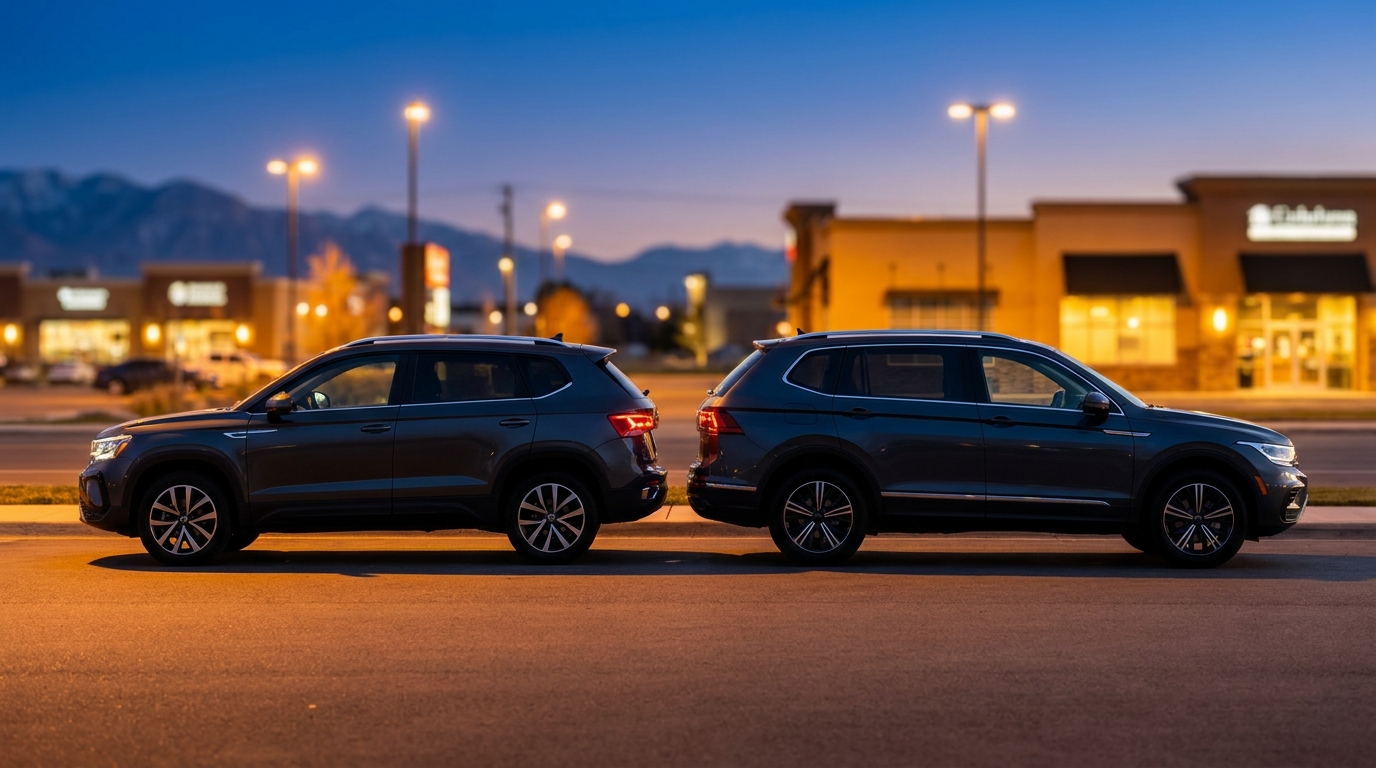
The 2026 Volkswagen Taos is the right pick if you want the lower price ($26,500 starting MSRP), better fuel economy (up to 31 mpg combined), and easier city maneuverability. The 2026 Volkswagen Tiguan ($30,805 starting MSRP) is the right pick if you need more power (up to 268 hp), more cargo room (33.8 cu ft behind the rear seats), and a more substantial feel for family duty and Wasatch road trips. Both seat five, both offer AWD, and both are sold side-by-side at Strong Volkswagen in West Valley City.
How do the 2026 Taos and Tiguan compare at a glance?
The Taos is Volkswagen's smaller, more affordable compact SUV with a 1.5L turbo making 174 hp, while the Tiguan is the larger, more powerful option with a 2.0L turbo making 201 hp standard or 268 hp on the top trim. The Tiguan costs about $4,305 more to start, hauls more cargo, and drinks more fuel. The Taos wins on price and MPG; the Tiguan wins on space and power.
| Spec | 2026 VW Taos | 2026 VW Tiguan |
|---|---|---|
| Starting MSRP | $26,500 | $30,805 |
| Engine | 1.5L turbo I4 | 2.0L turbo I4 |
| Horsepower | 174 hp | 201 hp (268 hp on SEL R-Line Turbo) |
| MPG combined | 31 (FWD) / 28 (AWD) | 25 (AWD) |
| Cargo behind rear seats | 27.9 cu ft | 33.8 cu ft |
| Cargo seats folded | 65.9 cu ft | 69.8 cu ft |
| Seating | 5 | 5 |
| Trims | S, SE, SE Black, SEL | S, SE, SE R-Line Black, SEL R-Line Turbo |
| Basic warranty | 4 yr / 50,000 mi | 4 yr / 50,000 mi |
MSRPs shown here are Volkswagen base prices and exclude destination charges, taxes, title, registration, and any dealer fees. Real drive-off pricing at Strong Volkswagen in West Valley City will vary by trim, options, and current incentives.
Which one is more affordable to buy and own in 2026?
The Taos is the more affordable choice on both fronts. It starts at $26,500 versus $30,805 for the Tiguan — a roughly $4,305 gap before options and fees — and it delivers 31 mpg combined in front-wheel drive form (28 city / 36 highway) compared with 25 mpg combined for the AWD Tiguan. Over a typical Utah commute, that MPG spread adds up.
For West Valley City drivers stitching together I-215, Bangerter Highway, and daily runs into downtown Salt Lake City, the Taos's smaller 1.5L turbo is genuinely cheaper to feed. If your driving is mostly solo commuting, school pickup, and errands, the Taos's price and efficiency edge is hard to argue with. Strong Volkswagen carries both models, so it's easy to sit in each and see whether the price gap feels justified for your use case.
Which has more power and better on-road feel?
The Tiguan wins on power. Its 2.0L turbo makes 201 hp on standard trims, and the top SEL R-Line Turbo jumps to 268 hp. The Taos's 1.5L turbo makes 174 hp and 184 lb-ft — plenty for daily driving, but not in the same league when you're merging onto I-15 with a full load or climbing Parley's Canyon toward Park City.
If you regularly drive into the Wasatch for skiing, camping, or weekend trips, the Tiguan's extra torque earns its keep on grades and passing maneuvers. The Taos handles the same routes competently — it's just working harder. For pure around-town driving in West Valley City, both feel more than adequate.
Which is better for cargo, families, and road trips?
The Tiguan offers meaningfully more cargo room: 33.8 cubic feet behind the rear seats versus 27.9 in the Taos, and 69.8 cubic feet with the seats folded versus 65.9. That's roughly 5.9 extra cubic feet where it matters most — behind the second row, where strollers, hockey bags, and Costco runs actually live.
Both SUVs seat five, and neither offers a third row, so if you need six or seven seats you'll want to look at the Atlas Cross Sport or Atlas instead. For a family of four with gear, the Tiguan is the more comfortable long-haul choice. For a couple or a small household, the Taos's cargo hold is often plenty.
Which handles Utah winters and mountain roads better?
Both models offer all-wheel drive suited to Utah conditions, but they take different approaches. The Taos offers AWD as an option and makes it standard on the SEL trim, while the Tiguan pairs 4Motion AWD with the larger 2.0L engine for a more capable overall package when roads get slick or steep.
West Valley City sits at the western edge of the Salt Lake Valley, where lake-effect snow, inversion season, and quick trips up SR-201 or I-80 toward the canyons are part of normal life. If you spend meaningful time above the valley floor — Alta, Brighton, Solitude, or east into the Uintas — the Tiguan's combination of AWD and stronger engine is the more confident tool. For city-bound drivers who mostly want AWD as a snow-day insurance policy, the Taos SEL is a smart, lower-cost answer. Opting for AWD on the Taos drops combined fuel economy from 31 to 28 mpg — still better than the Tiguan's 25 mpg combined.
How should West Valley City buyers decide between them?
Start with three questions: How much cargo do you actually haul? How often do you leave the valley floor? And how tight is your monthly budget? If the honest answers are "not much," "rarely," and "tight," the Taos is the smarter buy. If they're "a lot," "often," and "there's room," the Tiguan earns the extra $4,305.
Strong Volkswagen sits along the Wasatch Front's main dealership corridor and stocks both models across trims, which makes back-to-back test drives straightforward. Strong Volkswagen stocks both models across trims, making it easy to compare pricing and trade-in options in one visit. That kind of feedback matters when you're weighing two vehicles that share a showroom but serve different needs.
Frequently asked questions
Is the 2026 VW Taos or Tiguan cheaper?
The 2026 Volkswagen Taos is cheaper, starting at $26,500 versus $30,805 for the 2026 Volkswagen Tiguan — a difference of about $4,305 before destination charges, taxes, title, registration, and dealer fees. Both models have four trims, and the gap generally holds as you move up the trim ladder. Final pricing at any West Valley City dealer will depend on trim, options, and current incentives.
Which gets better gas mileage, the Taos or the Tiguan?
The Taos gets better gas mileage. In front-wheel-drive form it's rated at 31 mpg combined (28 city / 36 highway), and in all-wheel-drive form it's rated at 28 mpg combined. The 2026 Tiguan is rated at 25 mpg combined in AWD form, with trim-specific ratings ranging from 22/29 to 26/34 mpg city/highway. Over a typical Utah commute, the Taos will cost noticeably less to fuel.
Does the Volkswagen Taos come with all-wheel drive?
Yes. The 2026 Volkswagen Taos comes standard with front-wheel drive and offers all-wheel drive as an option on lower trims. AWD is standard on the top SEL trim. That makes it a practical choice for West Valley City buyers who want winter traction without stepping up to the larger, thirstier Tiguan.
How much cargo space does each SUV offer?
The 2026 Taos offers 27.9 cubic feet of cargo behind the rear seats and 65.9 cubic feet with the seats folded. The 2026 Tiguan offers 33.8 cubic feet behind the rear seats and 69.8 cubic feet with the seats folded. That's roughly 5.9 extra cubic feet of everyday cargo room in the Tiguan — the practical difference when loading strollers, sports gear, or grocery runs.
Which VW SUV is better for mountain and canyon driving?
The Tiguan is the stronger choice for mountain and canyon driving. Its 2.0L turbo makes 201 hp standard and up to 268 hp on the SEL R-Line Turbo, giving it more confident passing power and grade-climbing ability than the Taos's 174-hp 1.5L turbo. Paired with 4Motion AWD, it's better suited to regular runs up Little Cottonwood, Big Cottonwood, or Parley's Canyon.
Do the Taos and Tiguan have the same warranty?
Yes. Both the 2026 Volkswagen Taos and the 2026 Volkswagen Tiguan carry the same basic warranty coverage of 4 years or 50,000 miles, whichever comes first. Warranty coverage should not be a deciding factor between the two models — the meaningful differences are price, power, fuel economy, and cargo capacity.
The bottom line for West Valley City shoppers
The Taos is the value pick: lower price, better MPG, and enough room for most solo drivers, couples, and small families. The Tiguan is the capability pick: more power, more cargo, and a more substantial feel that pays off on Wasatch road trips and family duty. Neither is a wrong answer — they're aimed at different buyers who happen to want the same brand.
Readers in West Valley City who want to compare both back-to-back can reach Strong Volkswagen at https://www.strongvw.com to check current inventory, confirm trim-specific pricing, and schedule test drives in each model.