VW Tiguan vs Atlas: Which Should You Buy in Salt Lake City?
Comparing the 2026 VW Tiguan vs Atlas for Salt Lake City buyers. Size, seating, towing, fuel economy, and which VW SUV fits your Wasatch Front family best.
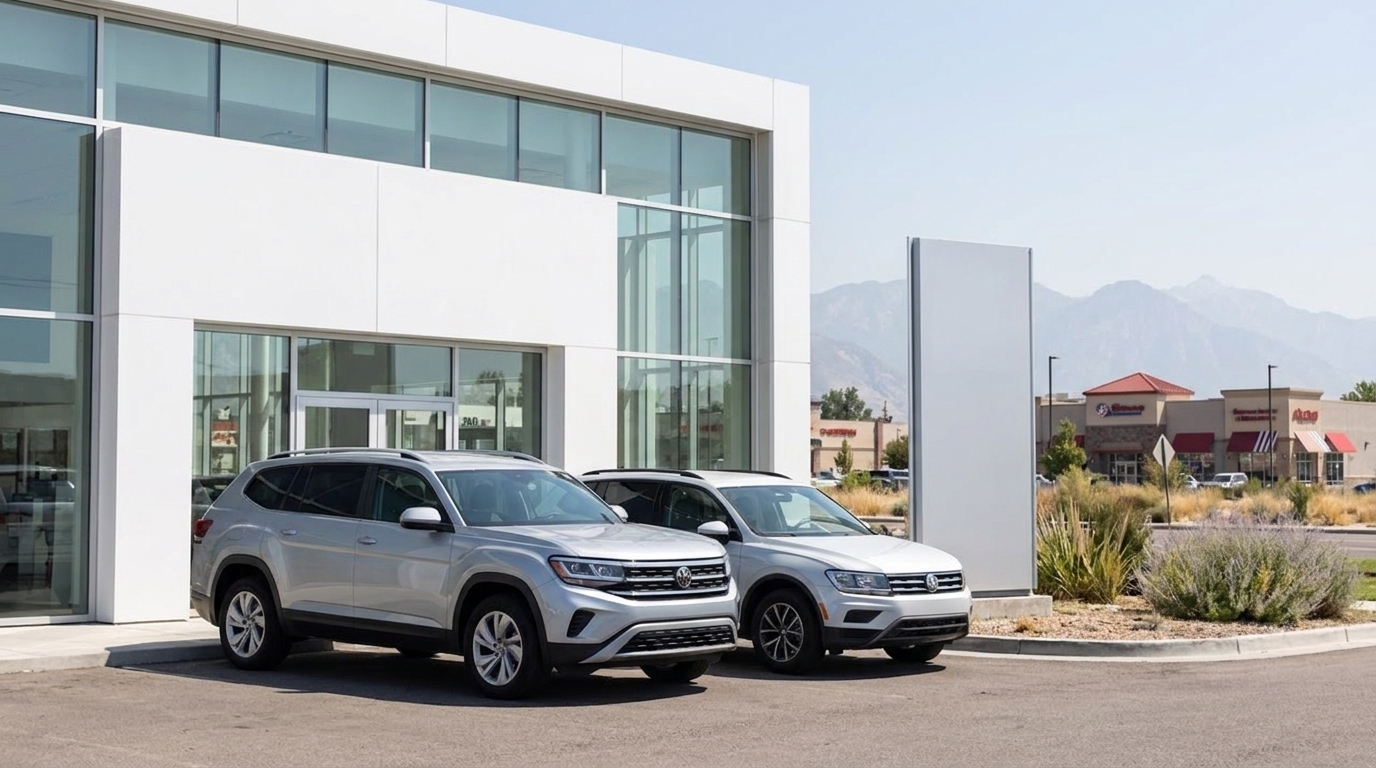
You've narrowed your next SUV down to a Volkswagen. Now the real question: the 2026 Tiguan or the 2026 Atlas? Both are well-built, both come with 4MOTION all-wheel drive options that make sense for Wasatch Front winters, and both carry the same 4-year/50,000-mile basic warranty. The difference comes down to size, power, towing, and how you actually use a vehicle in and around Salt Lake City.
Here's the short answer: the Tiguan is the right call for commuters, couples, and small families who value fuel economy and easier parking. The Atlas is the right call for larger households, regular tow-and-haul duty, and trips that fill every seat. Below is the detailed breakdown to confirm which one fits your life.
Tiguan vs Atlas Size Comparison
This is usually the first question buyers ask, and it's the most important one.
The 2026 Tiguan is a two-row compact SUV. It seats five, measures 184.4 inches long, and rides on a 109.9-inch wheelbase. The 2026 Atlas is a three-row midsize SUV. It seats seven standard and is meaningfully longer and wider than the Tiguan.
That size difference matters in real Salt Lake City driving conditions:
- Parking downtown: The Tiguan fits comfortably in tight garages near City Creek, the Gateway, and street parking in the Avenues. The Atlas works, but you'll feel its footprint.
- Canyon driving: The Tiguan feels more nimble heading up Big Cottonwood or Little Cottonwood. The Atlas is stable and planted but takes more road.
- Daily passengers: Two adults plus two kids? Tiguan is plenty. Three kids, car seats, or regular carpool duty? You'll want the Atlas's third row.
Which VW SUV Is Bigger Inside?
The Atlas is bigger in nearly every interior measurement that matters for hauling people and gear. Maximum cargo volume with all rear seats folded is 96.6 cubic feet in the Atlas, compared with 69.8 cubic feet in the Tiguan.
But there's a twist worth knowing. Behind the rearmost row in normal use, the Tiguan actually offers more cargo space than the Atlas—33.8 cubic feet behind the Tiguan's second row versus 20.6 cubic feet behind the Atlas's third row. If you regularly drive with all seats in use, the Tiguan's daily cargo area is more usable. The Atlas's advantage only shows up when you fold the third row down.
Translation: a couple with a dog and ski gear may find the Tiguan's everyday cargo layout better than expected. A family of five with weekly Costco runs from Sugar House will want the Atlas.
VW Atlas vs Tiguan for Families
For families, the deciding factors are seats, space, power, and towing.
Seating
The Atlas seats seven (or six with captain's chairs). The Tiguan seats five. If you regularly need to carry more than four passengers—kids' friends, grandparents, carpool to school in Holladay or Cottonwood Heights—the Atlas isn't optional, it's required.
Power
The Atlas runs a 2.0L turbocharged TSI inline-4 making 269 hp at 5,500 rpm and 273 lb-ft of torque at 1,600 rpm across all trims. The Tiguan uses a 2.0L turbocharged inline-4 tuned to 201 hp on the S, SE, and SE R-Line Black trims, or 268 hp on the top SEL R-Line Turbo. For most Tiguan buyers, that's 201 hp moving a smaller vehicle—adequate, not thrilling. The Atlas's torque curve is especially helpful loaded up on I-80 climbs toward Park City or pulling out of an on-ramp with a full cabin. It's also worth noting that both engines are turbocharged, which helps them maintain power at Salt Lake City's elevation and higher in the surrounding canyons.
Towing
This is where the Atlas separates itself. Properly equipped, it tows up to 5,000 lbs. The Tiguan tows up to 1,800 lbs. If you have a boat for Jordanelle or Bear Lake, a small camper for southern Utah, or a utility trailer, the Atlas is the only realistic choice between the two. Towing capacity figures are maximums when properly equipped; confirm the specific configuration with Strong Volkswagen before purchasing.
Fuel Economy and Daily Cost
The Tiguan is the clear efficiency winner. The FWD S trim leads the lineup in fuel economy, while AWD and higher-output Tiguan trims return lower numbers. The Atlas is rated lower across all configurations, with FWD trims outperforming AWD trims—and higher AWD trims returning the least efficient figures of the two models.
For a Salt Lake City commuter driving from Daybreak or Draper into downtown five days a week, that gap adds up over a year. Real-world numbers will drop in both vehicles during winter and on canyon climbs, but the Tiguan keeps its lead. Contact Strong Volkswagen for EPA window sticker figures on specific in-stock configurations.
Pricing: What You'll Actually Pay
The 2026 Tiguan and 2026 Atlas occupy meaningfully different price tiers, with the Atlas commanding a roughly $8,500 higher starting point before destination charges, taxes, title, registration, and dealer fees. Out-the-door costs in Salt Lake City will be higher than base MSRP for either model.
A few Salt Lake City realities to factor in:
- Utah dealers stock more 4MOTION AWD configurations than FWD because of mountain weather, so the FWD base price is often theoretical here. Plan on AWD pricing.
- The Tiguan offers four trims: S, SE, SE R-Line Black, and SEL R-Line Turbo. The Atlas offers five: SE, SE with Technology, Peak Edition, SEL, and SEL Premium R-Line.
- The Tiguan's 268 hp engine is exclusive to the SEL R-Line Turbo. If you want Tiguan power closer to Atlas territory, you're buying the top trim.
- A well-equipped Tiguan can approach the price of a base Atlas without offering the Atlas's seating or cargo capacity—something to weigh carefully at the top of the Tiguan lineup.
For current pricing on specific trims and in-stock vehicles, contact Strong Volkswagen at (801) 285-9033 or visit them at 1070 South Main Street, Salt Lake City, UT 84101.
Which One Should You Buy?
Buy the 2026 Tiguan if:
- You need to seat four or fewer regularly
- You commute daily and care about fuel economy
- You park downtown or in tight garages
- Your towing needs top out at a small utility trailer
- You want to keep your starting price meaningfully lower
Buy the 2026 Atlas if:
- You need a third row—regularly, not occasionally
- You tow a boat, camper, or trailer up to 5,000 lbs
- You road-trip with a full cabin and full cargo hold
- You want consistent 269 hp without paying for the top trim
- Cargo volume for moves, gear, and ski trips matters more than MPG
Frequently Asked Questions
Is the VW Atlas worth the extra money over the Tiguan?
If you use the third row, tow regularly, or carry full loads, yes—the roughly $8,500 starting price gap buys you a meaningfully different vehicle. If you don't, you're paying for capability you won't use and giving up fuel economy.
Which VW SUV is better for Utah winters?
Both offer 4MOTION all-wheel drive and handle snow well. The Atlas's longer wheelbase gives it slightly more stability on highway slush, while the Tiguan is easier to maneuver on unplowed neighborhood streets. Note that 4MOTION improves traction but does not replace dedicated winter tires, which are strongly recommended for Utah canyon driving.
Can the Tiguan handle Salt Lake City canyon driving?
Yes. The 201 hp tune is adequate for daily canyon trips, and the 268 hp SEL R-Line Turbo handles steep climbs without strain. The Atlas's torque advantage shows up most when fully loaded.
How many people can a 2026 Tiguan seat compared to the Atlas?
The Tiguan seats five across two rows. The Atlas seats seven across three rows standard, or six with optional second-row captain's chairs.
Does the 2026 Atlas have a better warranty than the Tiguan?
Both vehicles share the same 4-year/50,000-mile basic and powertrain warranty, plus 2-year/20,000-mile complimentary scheduled maintenance. The Atlas adds corrosion-perforation coverage for 7 years/100,000 miles and 3-year/36,000-mile roadside assistance—coverage not listed for the Tiguan. For buyers planning to keep their vehicle long-term, the Atlas's extended corrosion and roadside terms are a meaningful added benefit.
Which 2026 VW—Tiguan or Atlas—is better for towing in Utah?
The Atlas is the clear choice for towing. Properly equipped, it handles up to 5,000 lbs, making it suitable for boats on Jordanelle or Bear Lake, utility trailers, and small campers for southern Utah trips. The Tiguan is rated up to 1,800 lbs—fine for a small cargo trailer but not realistic for anything heavier. Always verify towing capacity on the specific vehicle's window sticker.
The Bottom Line for Salt Lake City Buyers
The Volkswagen SUV comparison in Salt Lake City almost always comes down to one question: do you need a third row and serious towing capacity? If yes, the Atlas is the answer. If no, the Tiguan saves you money up front, saves you fuel every week, and is easier to live with in the city.
Strong Volkswagen, rated 4.4 stars from 7,618 Google reviews as of June 2026, carries both models and can walk you through current trim availability and 4MOTION configurations. One customer wrote: "He gave the most straightforward pricing and fair trade-in value up front, which pleasantly surprised me." Another noted the team helped them get into a new Tiguan with a smooth, honest process. The most useful next step is to drive both back-to-back. Spec differences matter, but how each vehicle feels on I-15, in a parking garage, and on a canyon road tells you more than any spec sheet. Contact Strong Volkswagen at (801) 285-9033 to schedule test drives in both models.